

Container/X‑Ray Intelligence: Match Cargo to Declarations
- Nov 12, 2025
- 2 min read
Updated: Nov 19, 2025

Manual X‑ray review is slow and inconsistent; many containers pass unchecked and paperwork often doesn’t match what’s inside. InteliATE’s on‑prem, offline models read the declaration, analyze X‑rays, count items, and flag mismatches with green/amber/red outcomes and evidence reports—so teams move faster while protecting revenue and stopping smuggling. The system integrates with your existing scanners and runs entirely in your environment.
The problem ports face
Manual interpretation is slow, inconsistent, error‑prone; ~90% of containers pass unchecked. Declarations can be misclassified or undervalued. Systems are fragmented.
Outcome: missed revenue, slower clearance, and higher risk for smuggling hidden behind legitimate manifests.
What the system does (end‑to‑end)
Checks the paperwork. Reads shipping declarations; extracts items, quantities, codes, and weights.
Knows what “good” looks like. Links each declared item to a reference.
Looks inside the container. Ingests and analyzes the X‑ray.
Counts and compares. Tallies visible goods and estimates boxed items; compares to the declaration.
Spots what doesn’t belong. Flags undeclared or suspicious content.
Gives a clear result. Green (match), Amber (needs human check), Red (clear mismatch).
Provides proof. Produces an illustrated report with counts and images.
Example: A declaration says 100 bicycles; the system counts ~130 in the X‑ray and flags Red for potential tax evasion.

On‑prem, offline, and integrated
Deploy on‑prem or air‑gapped: disconnected from the internet, encrypted end‑to‑end, full user rights, with complete activity logs. “In‑a‑box” is available.
Use your current infrastructure. The platform plugs into existing scanners and workflows to reduce cost.
What you can detect
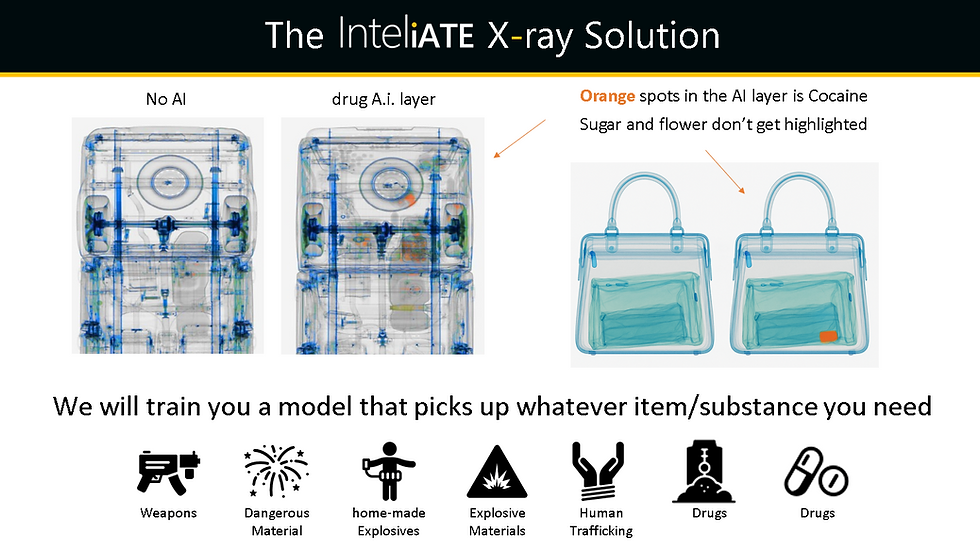
We train a model for the items or substances you care about—weapons, explosives, drugs, dangerous materials, and other risk indicators. Substance layers can distinguish targeted materials from benign ones (e.g., cocaine vs. sugar/salt in sample imagery).
Outputs and automation
Green/Amber/Red decision with overlays, counts, and a readable report for audit.
Optional downstream actions include smuggling notifications or an AI‑generated penalty draft (per agency policy).
Benefits called out in our materials: 80–90% reduction in manual work with higher accuracy.
Why this approach works
Models trained on your data for domain accuracy and privacy.
Lifecycle governance: data ingestion → model training → validation → deployment → retraining as threats or product mixes change.
Audit‑ready evidence: scans, counts, decisions, and activity logs in one place.
Implementation blueprint
Scope target commodities, HS codes, and risk scenarios.
Connect declaration feeds and X‑ray outputs from your scanners.
Calibrate counting and comparison thresholds; define “amber” review rules.
Pilot on a representative lane; measure review time saved and match quality.
Go live with RBAC, retention, and reporting; monitor alerts by route/carrier.
Retrain periodically using operator feedback and new exemplars.
FAQs to Container X‑Ray Intelligence Match Cargo to Declaration
Can this estimate items inside boxes?Yes. The Container X‑Ray Intelligence Match Cargo to Declaration system counts visible goods and estimates boxed items before comparing against the declaration.
Does it work with our existing scanners?Yes. It integrates with existing infrastructure to reduce cost and disruption.
Can it run completely offline?Yes. Deploy on‑prem or air‑gapped with encryption, user rights, and full activity logs.
What proof do we get for enforcement?An evidence report with scans and item counts, plus a clear decision (green/amber/red).